

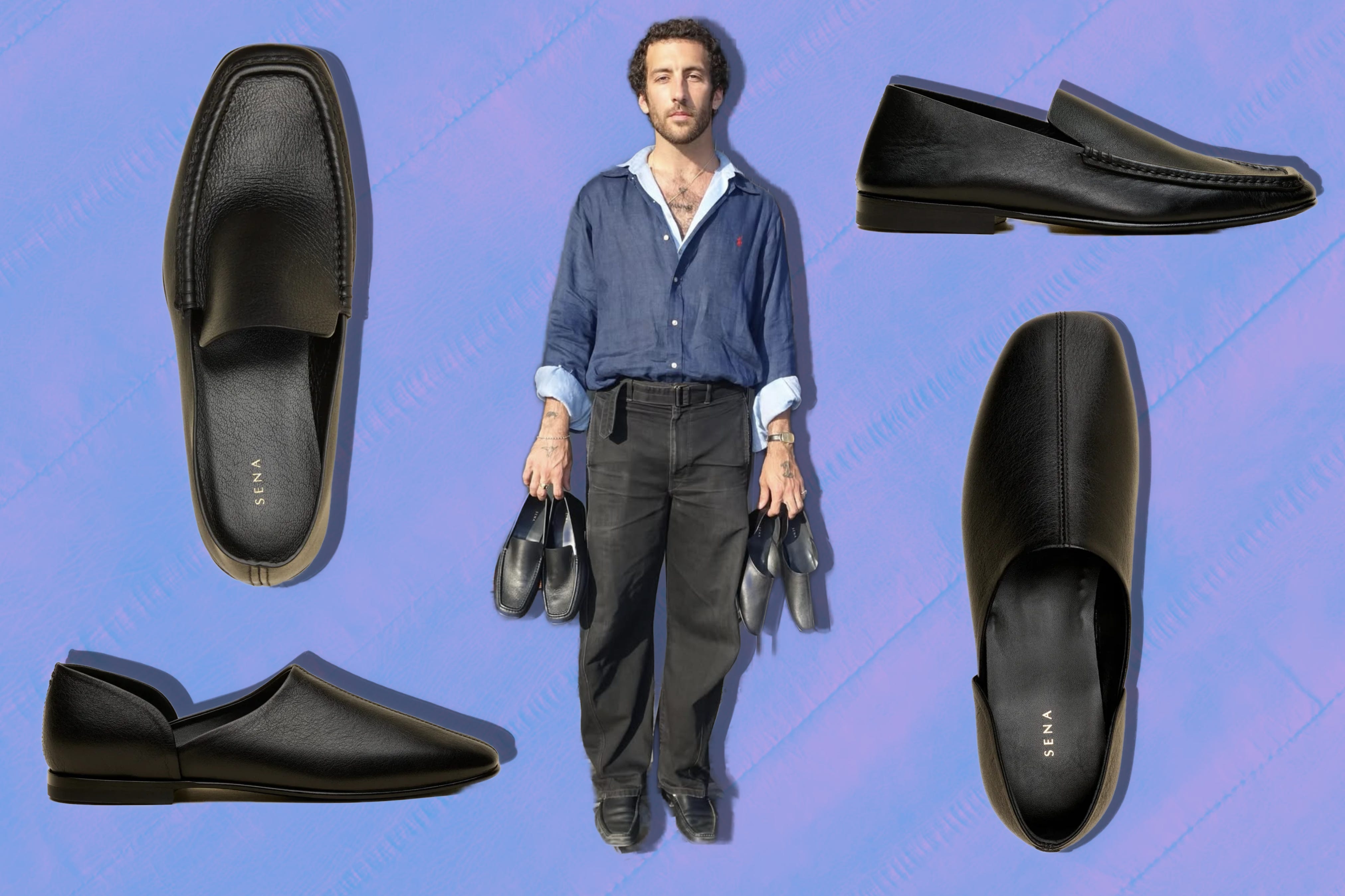
SUBSCRIBE BELOW TO RECEIVE AN EXCLUSIVE 15% OFF SENA SHOES.
William De Sena had a successful career making commercials for big brands when Covid stopped the world in March 2020. It was a reflective time for a lot of creatives whose work required them to be outside, and for De Sena, it led to a bit of an existential crisis. During lockdown, he wondered: did he want to continue to use his creativity to make glossy campaigns for other companies, or was there some bigger calling waiting for him out there?
But while his mind was in the clouds, back on earth, a real world wardrobe problem also needed attention. Namely, his favorite loafers needed re-soleing. Unfortunately, De Sena was told by a cobbler that the leather-soled shoes were, after numerous revitalization efforts, finally beyond repair. Unsure of what to do next, he purchased a pair of $1,600 loafers from YSL, sure that the price was commensurate with quality. Instead, they turned out to be a disappointment, and an extremely expensive mistake.
At this point, De Sena was feeling let down by both the advertising world and the state of shoes. So, as a self described extremist, he decided the best way to cheer himself up was to take a leap of faith into an entirely new industry, and, to make a long story short, make a pair of loafers of his own. He spent months tweaking the design—communicating via hand signals with an Italian shoemaker—until he finally had a pair of shoes he loved. He took them back to New York and wore them around town, which, according to De Sena, is when friends started asking him to make pairs for them, too.
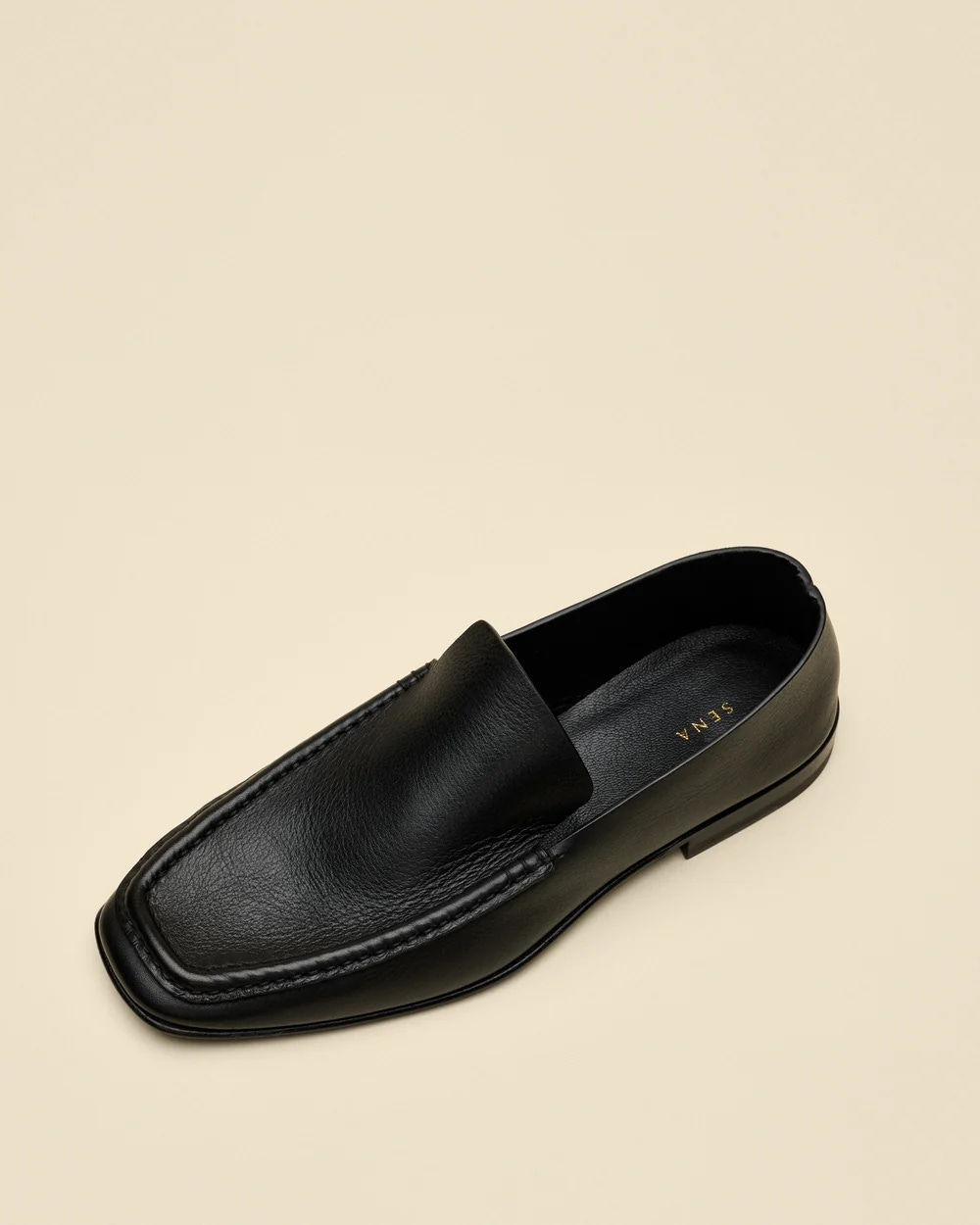
Nearly five years, thousands of dollars, and a lot of learning later, he launched his eponymous label SENA with two styles—the MILANA and YUTORI. And it’s hard to overstate at this point just how quickly they’ve become one of the “it” shoes to own among New York City’s most in-the-know, ahead-of-the-curve shoppers.
One of the most impressive things about SENA is the list of stores that carry the brand, which frankly, is a roster that might take some brands years to build, if ever. De Sena credits this rapid adoption in large part to vision of Chris Green and his IRL-only, Brookyln-based store Ven Space, which was the first retailer to take a chance on the brand with an order of 14 pairs. Today you can still buy the shoes at Ven Space (when they’re in stock, that is), but you’ll also find them at a murderer’s row of cool, high-end boutiques like Sorbara’s, &Son, and 180 the store, among a handful of upscale international accounts.
The question is: why has everyone in New York almost unanimously decided that SENA has the juice? Well, the first thing that I think has made the brand, and its MILANA loafer specifically, such a hit among this crop of ultra-discerning customers is the obvious: they look great. They’re soft, simple, low-profile, and boast a slightly square toe that doesn’t scream capital F-Fashion, but is certainly worth a double take. You add in the use of ultra supple calfskin leather for the uppers, and you’re left with a shoe that both looks elegant and is genuinely enjoyable to wear, whether you’re getting fully suited up with a shirt and tie, or just want something to slide into (thanks to the collapsable heels) as you head to the beach. The $695 price tag certainly ain’t cheap, but in a day and age when even sneaker prices can easily be twice that, it feels like a fair sum, especially when you consider the limited quantities and resources the brand is working with.
There’s also, from a consumer standpoint, a clarity to SENA’s vision that I think makes the brand appealing. It only offers two styles of shoes, and each is only available in black. (A third shoe is coming next month.) Part of this minimalism can be attributed to the limitations of being an indie startup, but it’s also indicative of the brand’s general philosophy. For one, De Sena is a believer in the concept of “less is more.” And why not? In a world that’s inundated with options, do we really need another brand to offer 100 SKUs?
But there’s something deeper behind the way SENA approaches the very idea of “brand,” too. To De Sena, the shoes he's selling are themselves an important part of expressing his creativity—but they’re also, more vitally, a way for him to collaborate with people he admires—whether that be stylists, photographers, actors, or musicians. But ultimately he wants SENA to be about, in his own words, “the exploration of the human condition.” It’s kind of a lofty idea for a shoe company, but after years of churning out glossy, picture perfect campaigns made solely to convey the idea that if you buy a product, you will become hotter, cooler, and in general better, it tracks that his next venture would be a partial rejection of that notion. Now, De Sena isn’t an anarchist, and is honest about the fact that, at the end of the day, SENA is a business that exists to sell shoes. But to him, that doesn’t mean on a creative level that campaigns should only be focused on making people and products look as cool as possible. Because that’s not real life.
Instead, while some SENA campaigns feature, for example, a woman joyously dancing through the streets, others show people crying. In one video, two elderly hands embrace in slow motion, without any faces, let alone shoes, to be seen. There’s an inherent acknowledgement within SENA’s campaigns that the things we wear aren’t just a kind of costume or armor—they are physical companions that are with us for all aspects of life. “Whether life is going good or bad, we just want to be a part if you’re willing to let us be a part,” De Sena says. It’s a subtle, but meaningful shift in terms of marketing approach, and one that’s designed to convey a level of self-awareness from the brand about the place a pair of shoes can and should occupy within a full life. So I think ultimately, in a world inundated with ads, bottom lines, and insatiable growth, people appreciate a kind of calmer, more quaint approach.
Below, I spoke to De Sena about starting his label, how brands can explore more than just happiness, what it’s been like to have his loafers become one of NYC’s most “it” footwear items, and his plans for the future of the label. (Hint: it involves more than just shoes!) Below that you’ll also find an exclusive 15% off if you’re a paid subscriber. Enjoy!!!
This post is entirely supported by subscriptions. There are no paid placements here, nor do I receive any kickback on any sales of SENA shoes. Thank you for subscribing!
JAKE WOOLF: Tell me what you were doing before you started the brand and then how you made that transition.
WILLIAM DE SENA: Where do I start? So I’ve been a filmmaker forever. I just started filming at 12 years old. I was obsessed with grabbing a video camera and shooting. My grandma was always shooting old home videos, VHS tapes, the whole thing. And I have all these photographs of me just holding it at that age. And by the time I was in middle school, I was taking it really seriously. I started filming skiing and action sports and skateboarding, all these type of things. In high school, it was already totally set in stone. I applied to one college only, that film school, and then all through college, I was pretty much just filming for clients already. So I’ve been a cinematographer, I’ve been a director, I’ve been an editor, I’ve been a photographer for forever.
Where did you go to film school?
I went to Boulder, Colorado. That was strictly because I was obsessed with skiing. It was just a dual addiction to skiing and then filming and then filming skiing. Very quickly, I graduated school and I realized there was just no money. I was like, “I’m going to be broke forever.” I was ski bum. I was literally living in my Subaru. So I drove to New York City and then immediately I found an agency here who saw some of my ski work and they were like, “Why don’t you film fashion and travel and sports and music videos?” And so it just kind of snowballed down into commercial filmmaking for so long.
The transition happened because of just COVID. It’s a COVID story. I was really existential at that point. The industry stopped, no one was on set, no one was filming commercials, everyone couldn’t travel. But I was just getting really depressed filming for other brands. Especially from the director standpoint, they ask for your brain. So if YSL hits you up or Nike or Cadillac or any of these people, they say, “Give us your brain. Let us use all your ideas and then let us slap our logo on it.”
After so many times of that, I just started to get kind of depressed because in my industry, sometimes you’re just a director, you’re just a cinematographer, but I was concepting even creative direction wise and I was editing, so there’s so much I was doing to make this idea happen for them. At the same time, I had a pair of loafers I loved and they fell apart and I brought them to my cobbler for the sixth time and he was like, “Look, I can’t fix these anymore. Stop. They’re done.” I went to YSL, I bought a pair of loafers. They were like 1,600 bucks and they sucked. Now, love the brand, love Anthony [Vaccarello]. But for whatever reason, that pair really sucked. And after that I was like, “Fuck this. You know what? I’m just going to go make my own pair.”
I’m kind of an extremist and I just go all in. I started to look into someone making a pair of shoes in New York, but then I was like, “Why don’t I just go do this in Italy?” These guys are already the best. They’ve been doing it for years. I’m of Italian heritage. My grandparents came from Italy and I was like, “Why don’t I just go back and touch the boots over there and see what it’s like.” And I found a guy who only was down to making a single pair of loafers because I filmed a soccer player he really loved for a commercial and he saw it. And he didn’t speak English and I don’t speak Italian. So for two years, we’re designing a shoe together face to face. I go over to Italy 10 times a year, one pair of shoes just for myself and not speaking each other’s languages.
This was even before ChatGPT was really a thing, so we’re on Google Translate. Like, we’re just drawing hand signals. And before I knew it I had one pair of shoes and then I brought them back and I had friends like, “Can I have a pair?” And another friend was like, “Can I have a pair? And then it just snowballed out of control.
Did you know you wanted it to be a brand at that point?
Well, it got to a point where I was like, “Wait a minute, everything that you hated about the commercial filmmaking world where you’re just giving all of yourself to someone else’s company, here is a moment in time where you created something you genuinely love.” I love loafers. I’ve worn them every day for 15 years. I love the shape. I love the art form. I love the artistry, and you can still create in regards to image making and feelings and moods and emotions through video and photo. But you can do it for yourself. It was just the perfect thing.
You’re able to still express yourself creatively in your original craft, but now through the lens of your complete vision with SENA as opposed to plugging into someone else’s vision.
100%. And so much of this really comes down to emotions. What I really want to create with SENA is the exploration of the human condition and what it feels like to have good times and bad times and what it feels like to be in love, but also heartbreak—what it feels like to live life, but also death. I think that it’s so hard for me to find a brand that isn’t talking about the greater scope of things. Now, you may not feel that yet with SENA, but we haven’t even been open for a year. So my hope is that within five years, you can really look at the brand and be like, “That brand is not scared at all to make a campaign that’s strictly about someone passing away.” Just like the heartfelt of grief or a breakup or maybe something didn’t go right.
My whole thing is like, “Why aren’t there more emotions tied into brands?” Well, capitalism says that it’s because fuck your emotion, fuck your feelings… we just need to make things look as cool as possible because that’s what sells. With SENA, we’re not even shoving product that much down your face. It’s much more about just trying to capture these feelings that we’re all dealing with all day, all of us, all of the human race, just these feelings of push and pull and trying to wrestle with. The moments in between, this is what I’m interested in exploring with SENA. I’m not interested in making everything look insane and cool all the time and high end. There has to be some realness to it and it’s really hard for me and I still don’t know many brands that explore this that deeply.
“It’s just tiny nuances changing shoes, but it makes all the difference. The first time we made the shoe, the tiniest difference, it looked god awful. I was like, ‘That is so bad. Wow. We’re going down the wrong path.’ But then he’s like, ‘Oh, watch this.’ The next day, he does something else. You get it back and you’re like, “Wow, this is amazing.” - William De Siena
The typical emotion that’s associated with selling product is this product will make you better than you are now. With SENA, however you are saying you’re not only interested in saying that this shoe will make you cool, but there’s other emotions to explore beyond that.
I made a video with a girl who’s on a ferry and she’s just crying. Now, whether you interpret that as a breakup, if you interpret that as she lost a loved one, if you interpret that she just lost her career, I don’t know. It doesn’t matter. It’s that she’s clearly having a really, really hard time and she’s just going through the ringer and she walks away with SENA’s on. That’s all it is. It’s like, dude, whether life is going good or bad, we just want to be a part if you’re willing to let us be a part. And if you don’t, all good. It’s like this is just stuff that I’m really interested in exploring. We have tons of campaigns in the canister that is kind of like these type of situations where it’s not that pretty. It’s not that great. It’s not that awesome. This campaign is going to show that life actually fucking sucked today and that’s totally cool and that’s fine.
Well, you have to wear shoes even when life sucks.
I think when you’re in the ad world for so long, you call bullshit on everything. You’ve seen under every single rug, you’ve seen all of the budgets, you’ve seen the product, the materials, you’ve seen the FOBs, you’ve seen the creative director from this brand and how the set went. A lot of it’s really ugly and it reeks a fakeness.
So I was like, if I create something like SENA, I don’t want it to ever feel tacky or cheesy or fake or not genuine. I want it just to feel like this company is really, really honest. Maybe they’re not blowing up into the next LVMH huge thing, but I know what I’m going to get from them and it’s always going to be much more intimate. It’s going to be much more personal. It’s going to feel heartfelt and that is all I could ask for at the end of the day. That would be success for me. SENA can stay as small as it ever will. I’m down with that. I just want people to really feel like this is genuine and it starts one from storytelling of course, but it also starts with just the products we make and not hindering any of our materials or the people we work with.
How did you decide on the two styles that you came out with? And why only two styles?
For me, less is more. And I really am not a huge fan of signifiers. I’m not a huge fan of logos. That goes into what I was saying is I call bullshit on the ad agency world in general. I never just want to be like a walking billboard for someone. So I was like, how do we make two shoes that feel simple and have them be different enough?
But a lot of this is also that I have no investors and I have no money. I mean, I’m pretty much filming commercials, paying rent in NewYork City, whatever’s left over I buy leather and it’s a vicious cycle. But this is not a small violin. It’s a great cycle because it forces you to do things, right? So it’s like we can only do black because I can’t afford brown.
What are some of the other challenges you face as such a small independent brand?
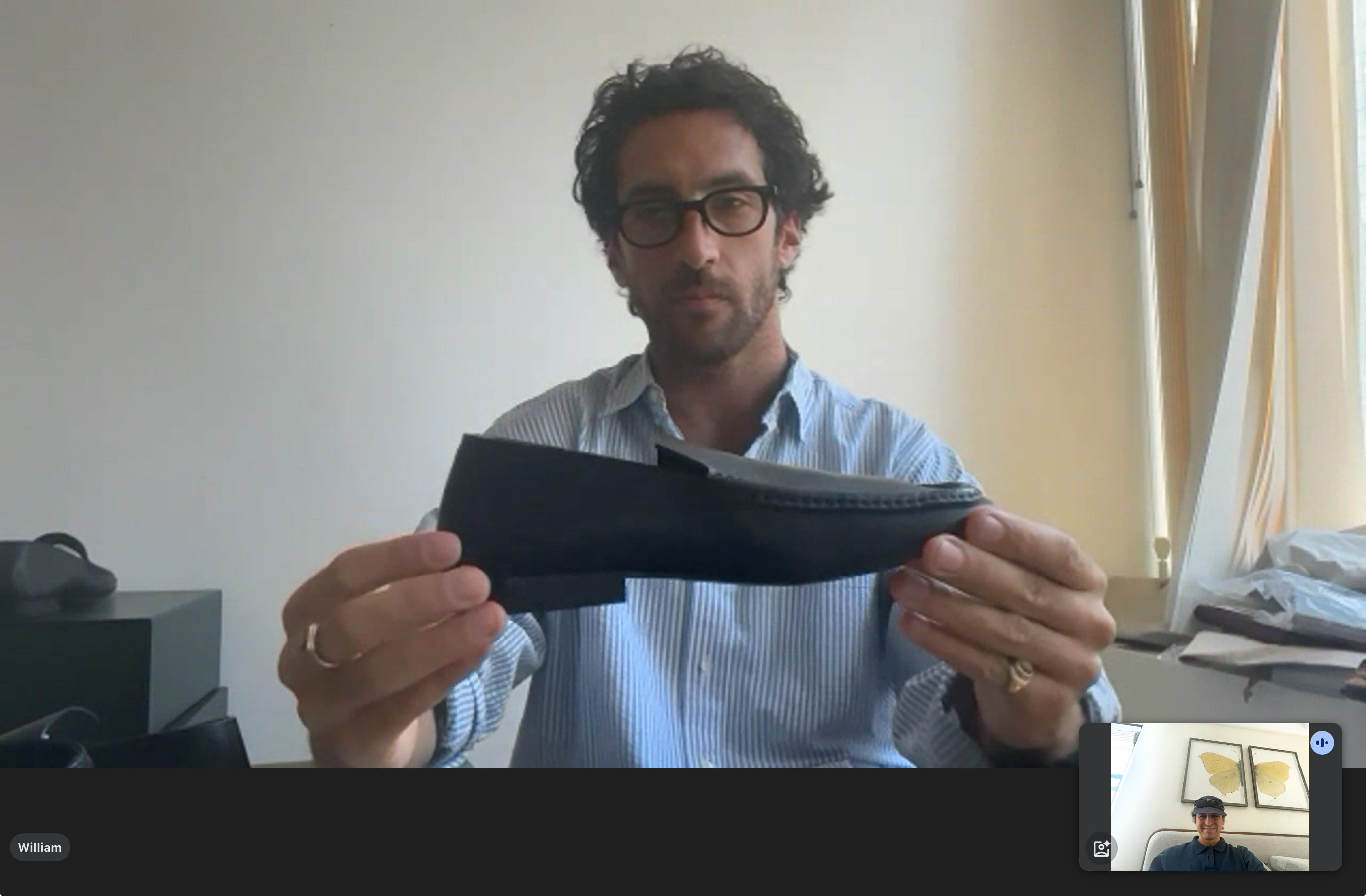
We make women’s shoes and men’s shoes from a scale from a 36 up to a 45. That’s a huge range. So even if I were to order a hundred shoes, that costs a ton of money, first of all, but then you can only do 10 per pair. So the first one, the MILANA, I just wanted something that felt like a race car. I wanted something that felt like a sailboat, like a swift sailboat, something that felt just very, very simple and that you could rock, dress up, dress down, that you can fold the back if you want in summer, where it’s just one giant piece of leather wrapped around your foot and then one on top.
A lot of times with shoes there’ll be a piece of leather on top, there’ll be the sectionalized heel, which is the second piece of leather, and then a third. I wanted to do even less, so we only have two pieces of leather. I love thin soles. I love leather soles. I’m not a huge fan of rubber because they’re more stiff. With time, these really start to flex. These are five millimeters. I love when the leather looks like it’s hovering over the pavement. There’s the whole chunky thing that’s cool and people rock it really well. It’s never been my style, never will be. And so the MILANA was born out of just, how do we make as simple as possible?
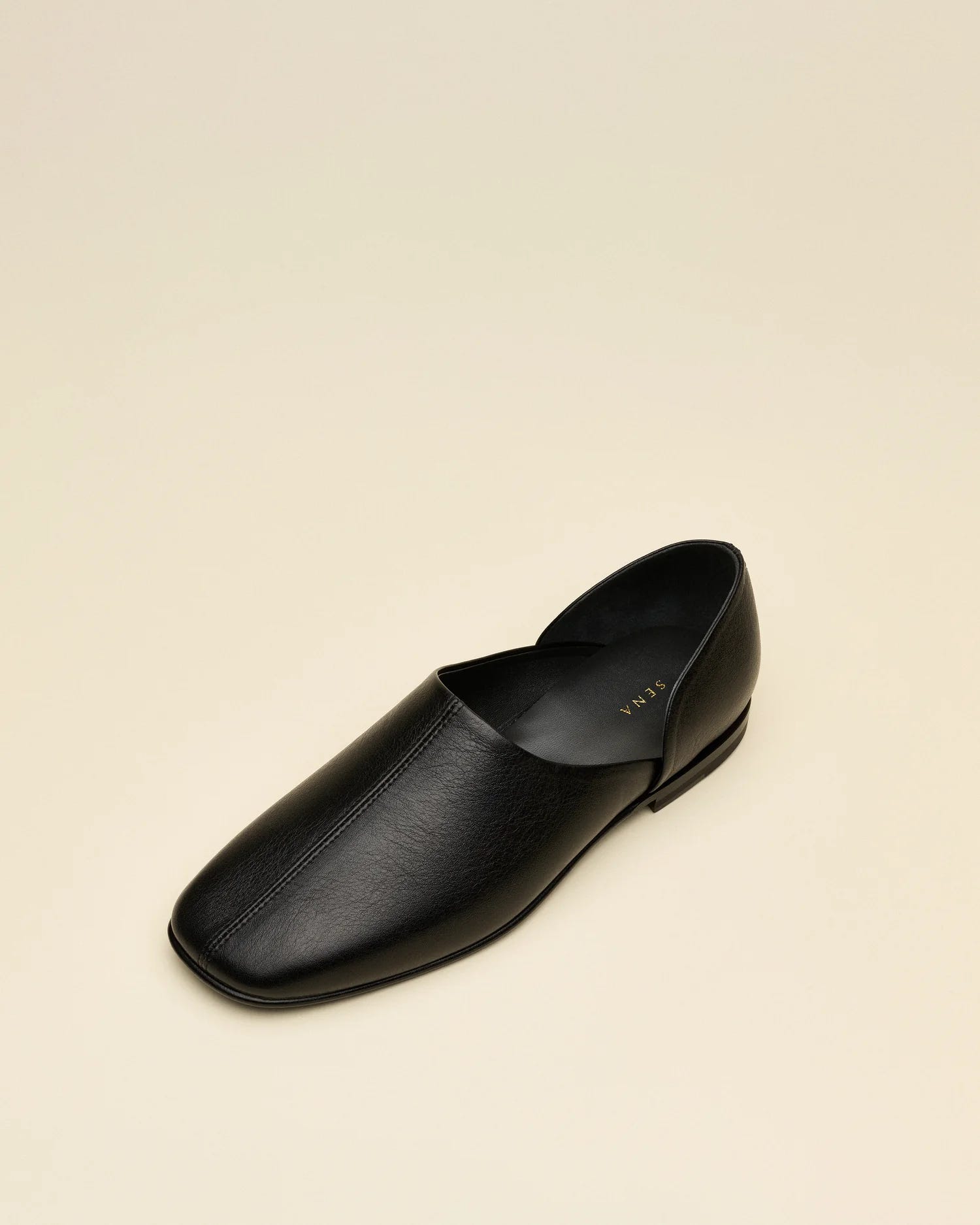
And then the YUTORI, I knew the YUTORI to be a Japanese school shoe. It’s very inspired by a Japanese school shoe. But actually, I was on set a couple months ago and my friend who’s from New Orleans, he was saying that New Orleans gangsters actually used to wear a lot of these types of shoes too. It’s two sections. There’s one in the back than this gap. They started showing me old black and white photos of these gangsters in New Orleans wearing shoes just like this. And so I was like, obviously these shoes existed, but my interpretation of it was just they all have their slight little hindrances, so I just wanted to change this.
We’re doing calf skin and we shape all of our shoes by hand. So that’s a big thing. I knew I wanted to make this Japanese inspired school shoe, but the shape is everything. And this is where we just carve this over and over, over the course of days and trying to get the toe to be exactly right with this little bit of this angle.
What you realize is, it’s just tiny nuances changing shoes, but it makes all the difference. The first time we made the shoe, the tiniest difference, it looked god awful. I was like, “That is so bad. Wow. We’re going down the wrong path.” But then he’s like, “Oh, watch this.” The next day, he does something else. You get it back and you’re like, “Wow, this is amazing.”
“They’re our vehicle to navigate this greater question of our time on earth. So, how do we want to spend it? Who do we want to spend it with? For me that’s with people who are building inspiring things.”
Especially you’re operating in the black leather shoe space, it really is about these small changes that you make to the product that separate the brand from others in the market. It also can make people love it or hate it.
Yeah. It’s so delicate, isn’t it? I mean, the design language, it’s the smallest of nuances, the tiniest little changes that shape everything. Now that I’ve been in it for years and we’re doing it with the best artisans using the best leather, I can just now tell the difference between a $300 loafer and a thousand dollar loafer. I can just see it. It’s the smallest things. You really have to be obsessed with design to really start to see these nuances. I don’t think my dad would really be able to tell a difference.
That’s why the branding side of it is so important because you’re trying to distill all of this hard work that you put into these small micro design decisions in a way where you don’t have to explain that to everyone. That’s the ultimately the idea, right? You’ve done all this work pre-work, but really the challenge is how do you communicate that emotion that you feel with the product to the end consumer? Because there are certain consumers, and I’m probably one of them, who will be like, “Oh yeah, tell me about the construction. Tell me about the leather and where did you source it and blah, blah, blah, blah, blah.” But there are other people who just don’t care about any of that and they will connect to the video of the girl crying.
100%. But beautiful thing about it is, SENA’s not for everyone. It’s expensive. It’s $700. It’s a lot. But I don’t have any fear or anxiety with SENA because one, I know that we’re building with the highest materials and I know it’s honest and I know they’re fucking expensive to make and it’s great. None of my moral compasses feels guilty or anything. I’m like, “These are amazing. I love these. I think the material’s amazing. I think the artisans who build this are amazing,” but they’re 700 bucks. For some people, SENA will never make sense because it’s just too much to spend on shoes.
Now, if you are in the market where that price makes sense, I think it’s the best bang for your buck because I know for a fact that it costs more than the majority of brands that are charging $1,400, 1600, 2000. These [SENA shoes] are more expensive to build. My whole thing going into this, I was like, “Okay, you have a career that’s sustainable.” That’s a blessing. I don’t have an investor. Maybe one day that happens, but for right now, you have this moment where you don’t have to shy away from materials, from great materials. I can choose the best of the best.
I just want the best made shoe I can do, and that’s what I want to spend my time doing. But ultimately, the shoes are just our vehicle to the human condition. They’re our vehicle to navigate this greater question of our time on earth. So, how do we want to spend it? Who do we want to spend it with? For me that’s with people who are building inspiring things. I love how SENA’s introduced me to so many amazing people who are building such incredible things. That little moment sitting at a table in Paris, meeting you, I’m like, “This is what SENA is about. This is actually what it’s about.”
The brand’s been around for less than a year. But I’ve seen the shoes in so many places, not only on people in Paris and things like that, but in a lot of stores in New York. What has that been like for you as someone who’s had this brand for less than a year, how excited people have been and their response?
It’s really cool. The guy who really champions me, and I have to thank him over and over again, is one, a handful of friends who just told me to keep going, but really is Chris at Ven Space. I mean, I walked in there, a cold email, just holding two boxes, SENA boxes, one with the YUTORI, one with the MILANA. I sat down with him 10 minutes and told him my story in a quick elevator pitch. And he was like, “I’m down.” I was like, “What?” And he was like, “I’m down to carry you. This is cool.” He was like, “These feel amazing. We don’t have anything like this right now.” I walked away and dude, I immediately started crying. I was walking down the street sobbing because I was just like, “Holy shit. I’ve been working on this for three years. I have spent most of my savings.” My parents were calling me saying, “Go, but stop. You’re burning your savings.” I was flying in between Italy and New York like 10 times a year.
There was so much belief in it, but as an artist, man, there’s so much doubt too. It’s human to be fearful. There was times when I was sitting on trains in Italy being like, “What are you doing here? What the fuck are you doing?” I had a number I was willing to spend and I went over 25X. So for that to happen and for Chris to take those first... I think he ordered like 14 shoes. It wasn’t even that many, but it just broke me. I was like, “Wow.”
I didn’t ask anyone else, but I think that that kind of snowballed and legitimized SENA in a way where then... I know 180 the store was down and Colbo was down and then Mohawk General Store was down and Sorbara’. And now we’re in two stores in Tokyo. I think it just solidified that and I’m very grateful towards him and his willingness to—
Take a chance on something new that had never been sold before.
It’s huge. So now it’s just me operating the whole thing, which I’m realizing takes a lot of time. I don’t even have really capacity to reach out to any more stores right now. I’m not even trying to expand. I’m just trying to make our third shoe, and make it well. I want it to be really great. And right now, obviously these are our two main shoes, but we have a lot in the future. I mean, we have a boot in prototype right now. We have a third shoe about to release. We’re in design for our fifth shoe, which will be next spring.
I was going to ask you because right before this call on the brand’s Instagram story, it was like, “Something exciting is coming.” So I was curious as to what that was.
We have a third shoe. I’ve been working on it for two years now. A big brand could probably get it out from initial concept point within nine months. But it’s taken me two years, which, it’s all good. It’s not like our other two whatsoever. It’s the first time we’re shifting away from black. It’s going to be a very deep espresso brown shoe, and it is a little sporty, but while maintaining the visual language of a high-end loafer. I think this is what differentiates it from the market is I wanted something sporty, but at the same time, you feel like you could wear it to a high-end event or some sort of luxurious thing and get away with it because it totally works for your entire outfit.
Hopefully that will be out at the end of October. We’re going to do a little event at Sorbara’s on October 15th. And the boot too, I mean, it’s cool. The whole thing is less is more. The third shoe is definitely not so much of that ethos, but I think even when you do-
It’s just a little more out there, is that why?
Yeah, but still lives in this realm. It’s really cool. I’m excited for it.
We’ve talked a lot about feelings with products, and how they can tap into deeper emotions than just the aesthetic joy of wearing something. So I guess I’m curious to know, how do you want people to feel wearing a SENA shoe?
I think at the end of the day, all of us just want to feel heard and understood. My hope is that when you wear SENA, you can feel some sort of connection, not to the shoe itself, but to the story that we’re trying to tell here. I’m really trying to open up more honestly, I think, to talk about life, the good and the bad, like I said. I think that when you wear SENAs, I hope you don’t feel like there’s any sort of part of it that is fake or manipulative or just clearly an ad for an ad or just totally trying to expand into VC for money and any of this stuff. I really hope people can feel the intimacy of the message we’re trying to tell and the thing we’re trying to explore, which again is human condition. I just feel that when people wear them, they’re like, “Oh wow, this brand feels much more personal.”
So just so people know, they always shoot me a message. I respond to everything on Instagram. I respond to every kind of email. It’s just me, man. It’s literally just me. So when people buy, they’re like, “Oh, I’m buying for this singular person who I have heard about or I would like to meet or I can actually just talk to.”
How important is it to you to preserve that feeling as the brand grows, that personal touch? Do you have aspirations of 10 years from now having five SENA stores and 50 different SKUs and all this kind of stuff? Do you allow yourself to think in those terms?
I do. In five years, my plan would be like I would love to get into suiting. I love men’s and women’s suiting.
You want to expand beyond shoes?
Yeah, shoes will for sure forever be our anchor. But I never want to expand too fast. I’m not interested in that. I’m interested in doing something, getting it done really, really well over time. Now, if that just means shoes for 10 years, great. I do love suits and I do feel like it fits the SENA realm. I do love little things like scarves, these type of things, and I would love to have SENA stores, but to preserve the messaging here and to preserve this kind of forever question and exploration, that’s what means more to me than anything.
It’s funny, I was talking to someone and this was a year ago and she wanted to help the brand out. I’m not going to name names, but she was in the realm of being able to. She’s like, “Yeah, at the end of the day, we just want to sell to LVMH. That’s all we need. That’s when we...” And I was like, “Whoa, cool, but we’re not in line.”
So, you might say I’m too much of an artsy-fartsy person. But listen, I do have a business sense. I did take two years of business school alongside film school. I know what I’m saying here, and I just believe that at the end of the day, what consumers... And I even hate to use that word, but what people really want is they want to feel a little bit more honesty from a brand and a little bit more intimacy and a little bit more just like, “Stop fucking with all the bullshit. Stop all the fake shit. Just tell me what it is and how it is.”
So I will always preserve that to the best of the ability. Too often money comes in and capitalism just takes over, but that’s my job to figure out. So yes, I need to think about, like, how does SENA maintain a business? How does it grow as a business, but how does it retain that ethos as a voice? And that’s everything to me.
That’s a big challenge.
I mean, dude, it’s going to be the biggest challenge in the world. Everything gets destroyed by capitalism, end of the day. Movies get destroyed by capitalism, brands get destroyed, everything comes in, VCs come in, everything gets manipulated. I’m dealing with that right now in the film world of things. And it’s just like, man, but it is possible. The through line is so thin, but you can make it through and there’s some rare people to do. So it will make it. I believe in that.
